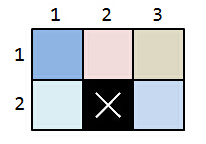
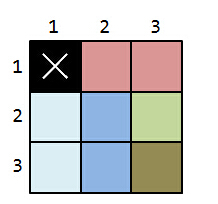
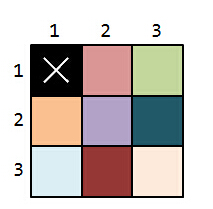
这个题就是给出一个大矩形n*m,其中有个1*1的小格子不能被占用,然后要你用很多小矩形去填满,问小矩形的最小最大面积是多少。
显然小矩形必然是1*x的最好,毕竟i*x,若i>1则还是可以拆成很多1*x。
显然若没有那个被占用的格子,那么答案就是min(n,m)+1>>1。
当考虑这个格子的时候,我们把矩形调整下,保证n<m,然后就很显然,除了被格子占用的那一列j,其他的列k,无论k<j还是k>j必然至少有一个还是用(min(n,m)+1>>1)*1的矩形去竖着填最好,那么考虑只有一个被这种方案填了,那么另一个肯定要用这种方案或者考虑横着填。这两种情况画出来就是这样:
上面的图,同一种颜色代表由同样的1*x的小矩形组成的部分,第一张图的左边是横着插,第二张图右边都是竖着插。
于是就可以很显然的推出式子。另外再单独考虑n=m,且都是奇数,切被占格子在正中间的情况即可。
#include<map>
#include<string>
#include<cstring>
#include<cstdio>
#include<cstdlib>
#include<cmath>
#include<queue>
#include<vector>
#include<iostream>
#include<algorithm>
#include<bitset>
#include<climits>
#include<list>
#include<iomanip>
#include<stack>
#include<set>
using namespace std;
int a[10];
int main()
{
	int n,m,x,y;
	while(cin>>n>>m>>x>>y)
	{
		if(n==m&&(n&1)&&x==n+1>>1&&y==x)
		{
			cout<<(n+1>>1)-1<<endl;
			continue;
		}
		if(n>m)
		{
			swap(n,m);
			swap(x,y);
		}
		a[0]=x-1;
		a[1]=n-x;
		a[2]=y;
		a[3]=m-y+1;
		a[4]=n+1>>1;
		int ans=max(a[4],min(max(a[0],a[1]),min(a[2],a[3])));
		cout<<ans<<endl;
	}
}
Time Limit: 4000/2000 MS (Java/Others) Memory Limit: 131072/131072 K (Java/Others)
Total Submission(s): 1237 Accepted Submission(s): 335
2 3 2 2
3 3 1 1
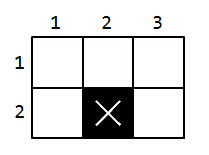
1 2HintCase 1 :You can split the floor into five 1×1 apartments. The answer is 1. Case 2:You can split the floor into three 2×1 apartments and two1×1 apartments. The answer is 2.If you want to split the floor into eight 1×1 apartments, it will be unacceptable because the apartment located on (2,2) can‘t have windows.
版权声明:本文为博主原创文章,未经博主允许不得转载。
原文:http://blog.csdn.net/stl112514/article/details/47043967