
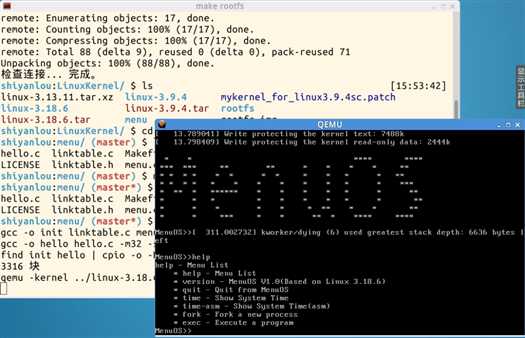
使用实验楼,配置menuOS:
打开gdb,设置断点,其中switch_to为宏定义,不能设置断点,需到context_switch函数中单步执行查看调用:
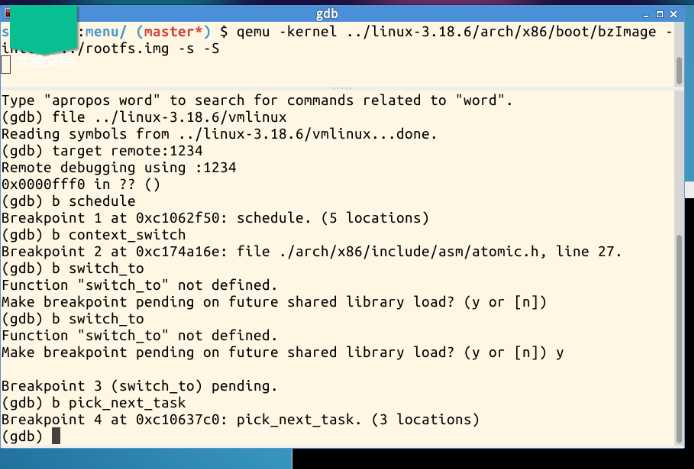
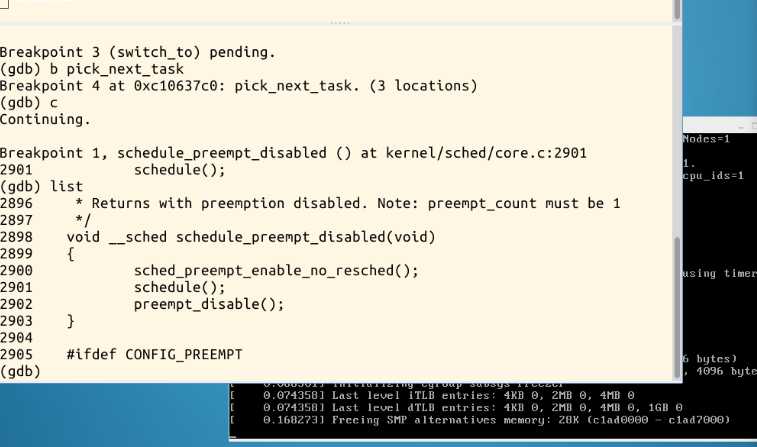
执行程序,停在了schedule函数处,查看代码发现调用了schedule函数,发生了进程调度:
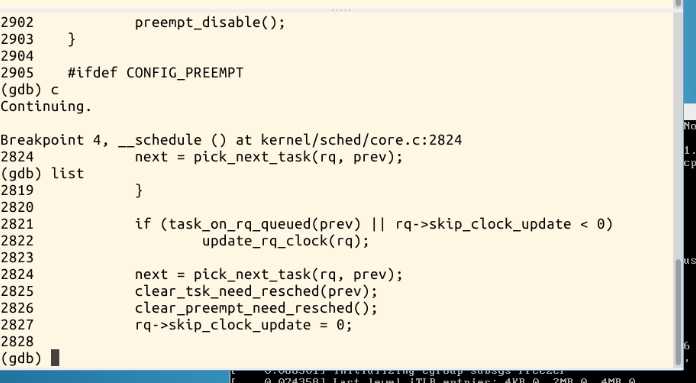
继续执行程序,代码来到了pick_next_task断点处:
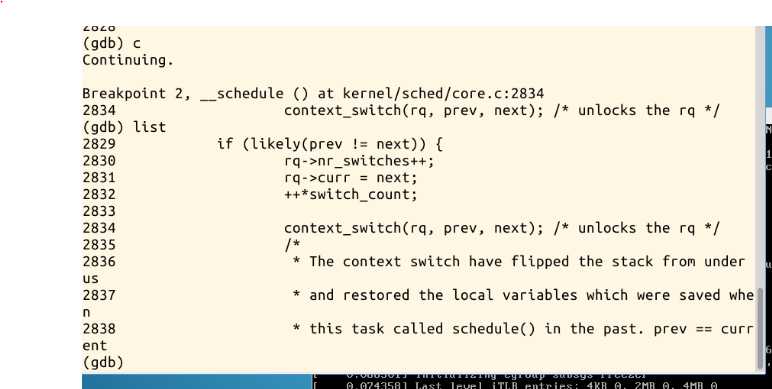
继续执行,来到了context_switch处:
在context_switch中单步执行,发现其中调用到了switch_to:
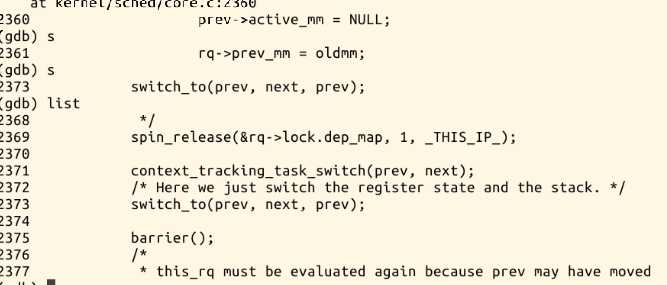
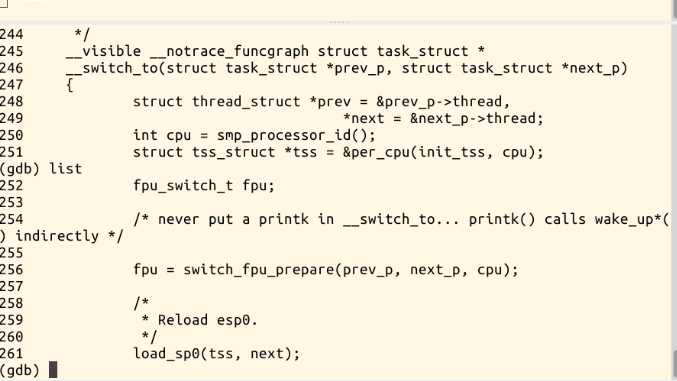
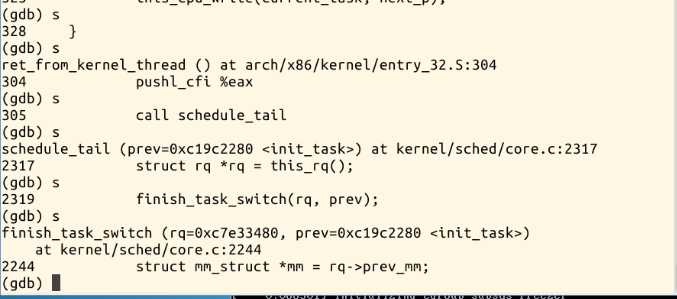
继续单步执行,结束切换:
context_switch函数部分
static inline void context_switch(struct rq *rq, struct task_struct *prev, struct task_struct *next)
{
    struct mm_struct *mm, *oldmm;

    prepare_task_switch(rq, prev, next);

    mm = next->mm;
    oldmm = prev->active_mm;
    /*
     * For paravirt, this is coupled with an exit in switch_to to
     * combine the page table reload and the switch backend into
     * one hypercall.
     */
    arch_start_context_switch(prev);

    if (!mm) {    //如果被切换进来的进程的mm为空切换,内核线程mm为空
        next->active_mm = oldmm;  //将共享切换出去的进程的active_mm
        atomic_inc(&oldmm->mm_count);  //有一个进程共享,所有引用计数加一
        enter_lazy_tlb(oldmm, next);  //普通mm不为空,则调用switch_mm切换地址空间
    } else
        switch_mm(oldmm, mm, next);

    if (!prev->mm) {
        prev->active_mm = NULL;
        rq->prev_mm = oldmm;
    }
    /*
     * Since the runqueue lock will be released by the next
     * task (which is an invalid locking op but in the case
     * of the scheduler it‘s an obvious special-case), so we
     * do an early lockdep release here:
     */
    spin_release(&rq->lock.dep_map, 1, _THIS_IP_);

    context_tracking_task_switch(prev, next);
    // Here we just switch the register state and the stack.切换寄存器状态和栈
    switch_to(prev, next, prev);

    barrier();
    /*
     * this_rq must be evaluated again because prev may have moved
     * CPUs since it called schedule(), thus the ‘rq‘ on its stack
     * frame will be invalid.
     */
    finish_task_switch(this_rq(), prev);
}
schedule函数选择一个新的进程来运行,并调用context_switch函数进行上下文的切换
switch_to函数部分
#define switch_to(prev, next, last)
do {
    /*
     * Context-switching clobbers all registers, so we clobber
     * them explicitly, via unused output variables.
     * (EAX and EBP is not listed because EBP is saved/restored
     * explicitly for wchan access and EAX is the return value of
     * __switch_to())
     */
    unsigned long ebx, ecx, edx, esi, edi;

    asm volatile(
                     "pushfl\n\t"        // 保存当前进程flags
             "pushl %%ebp\n\t"      // 当前进程堆栈基址压栈
             "movl %%esp,%[prev_sp]\n\t"    // 保存ESP,将当前堆栈栈顶保存起来
             "movl %[next_sp],%%esp\n\t"    // 更新ESP,将下一栈顶保存到ESP中
                     // 完成内核堆栈的切换
             "movl $1f,%[prev_ip]\n\t"       // 保存当前进程的EIP
             "pushl %[next_ip]\n\t"       // 将next进程起点压入堆栈,即next进程的栈顶为起点,next_ip一般为$1f,对于新创建的子进程是ret_from_fork
             __switch_canary
             "jmp __switch_to\n"    // prve进程中,设置next进程堆栈,jmp与call不同,是通过寄存器传递参数(call通过堆栈),所以ret时弹出的是之前压入栈顶的next进程起点
                     // 完成EIP的切换
             "1:\t"             // next进程开始执行
             "popl %%ebp\n\t"       // restore EBP
             "popfl\n"          // restore flags

             // 输出量
             : [prev_sp] "=m" (prev->thread.sp),   // 保存当前进程的esp
               [prev_ip] "=m" (prev->thread.ip),     // 保存当前进仓的eip
               "=a" (last),

               // 要破坏的寄存器
               "=b" (ebx), "=c" (ecx), "=d" (edx),
               "=S" (esi), "=D" (edi)

               __switch_canary_oparam

              // 输入量
             : [next_sp]  "m" (next->thread.sp),   // next进程的内核堆栈栈顶地址,即esp
               [next_ip]  "m" (next->thread.ip),     // next进程的eip

               // regparm parameters for __switch_to():
               [prev]     "a" (prev),
               [next]     "d" (next)

               __switch_canary_iparam

             : // 重新加载段寄存器
            "memory");
} while (0)
context_switch调用宏switch_to进行硬件上下文切换,主要是内联汇编代码
原文:https://www.cnblogs.com/intoxication/p/10092016.html