
| Time Limit: 2000MS | Memory Limit: 10000K | |
| Total Submissions: 18013 | Accepted: 5774 |
Description
Input
Output
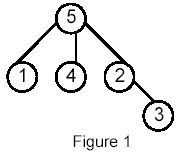
Sample Input
5
5:(3) 1 4 2
1:(0)
4:(0)
2:(1) 3
3:(0)
6
(1 5) (1 4) (4 2)
      (2 3)
(1 3) (4 3)
Sample Output
2:1
5:5
有向图求LCA,注意输入的处理。
有向图只有一个树根,利用并查集求树根。无向图中可选任意一点作树根,在dfs是比有向图多一个条件,详情见代码。
#include"cstdio"
#include"cstring"
#include"vector"
using namespace std;
const int MAXN=1005;
int V;
vector<int> G[MAXN];
int par[MAXN];
void prep()
{
    for(int i=0;i<=MAXN;i++)
    {
        par[i]=i;
    }
}
int fnd(int x)
{
    if(par[x]==x)
        return x;
    return par[x]=fnd(par[x]);
}
void unite(int father,int son)
{
    par[son]=fnd(father);
}
int fa[MAXN],dep[MAXN];
void dfs(int u,int father,int d)
{
    fa[u]=father,dep[u]=d;
    for(int i=0;i<G[u].size();i++)
         dfs(G[u][i],u,d+1);//在无向图中 需要加上 if(G[u][i]!=father)
}
int lca[MAXN];
int LCA(int u,int v)
{
    while(dep[u]>dep[v])    u=fa[u];
    while(dep[v]>dep[u])    v=fa[v];
    while(u!=v)
    {
        u=fa[u];
        v=fa[v];
    }
    return u;
}
int main()
{
    while(scanf("%d",&V)!=EOF)
    {
        for(int i=0;i<=V;i++)    G[i].clear();
        prep();
        memset(lca,0,sizeof(lca));
        for(int i=0;i<V;i++)
        {
            int u,t;
            scanf("%d:(%d)",&u,&t);
            while(t--)
            {
                int v;
                scanf("%d",&v);
                G[u].push_back(v);
                unite(u,v);
            }
        }
        int root=fnd(1);
        dfs(root,-1,0);
        int Q;
        scanf("%d",&Q);
        while(true)
        {
            char ch=getchar();
            if(ch==‘(‘)
            {
                int u,v;
                scanf("%d %d",&u,&v);
                int a=LCA(u,v);
                lca[a]++;
                Q--;
                getchar();//不能丢,有开就有闭
            }
            if(Q==0)    break;
        }
        for(int i=0;i<=V;i++)
        {
            if(lca[i]!=0)    printf("%d:%d\n",i,lca[i]);
        }
    }
    return 0;
}
原文:http://www.cnblogs.com/program-ccc/p/5171158.html